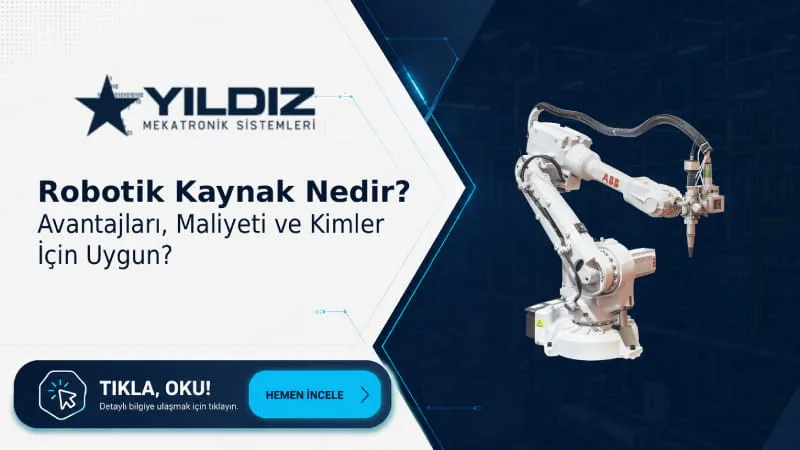
What Is Robotic Welding? Benefits, Cost, and Who It's For
Inconsistent weld quality, rising labor costs, and a shortage of skilled welders are common headaches for manufacturers. Robotic welding answers all three problems at once. In this guide, we explain what robotic welding is, the benefits it delivers, what it costs, and which businesses it suits best. Our goal is simple: to help you make a confident, informed decision.
What is robotic welding? Robotic welding is a manufacturing process in which a programmable robot arm guides a welding torch to join metal parts automatically. It is most common in MIG/MAG, TIG, and spot welding. The method reduces manual labor, delivers repeatable quality, and offers high speed and consistency in volume production.
How Do Robotic Welding Systems Work?
A robotic welding cell relies on several components working in harmony. First, the robot arm (the manipulator) moves the torch along a programmed path. Next, the welding power source supplies the current and feeds the wire. Finally, the controller manages the entire process.
The core parts of a system are:
- Robot arm: Positions the torch precisely in three-dimensional space.
- Positioner (rotary table): Turns the part to the optimal welding angle.
- Welding power source: Provides current for MIG/MAG or TIG.
- Sensors: Laser or 3D vision systems track the seam.
- Safety fence/cell: Separates the operator from the work zone.
Thanks to 3D vision, the robot detects the part's actual position. As a result, even small placement deviations are corrected automatically. This lowers fixture costs and increases flexibility.
What Are the Benefits of Robotic Welding?
Robotic welding benefits show up on both the production floor and the balance sheet. Here are the most important ones.
- Consistent quality: The robot lays every weld with identical parameters, so defect rates typically drop sharply.
- Higher productivity: The robot works without breaks, so cycle times usually shorten in volume jobs.
- Material and gas savings: Optimized parameters reduce wire and shielding-gas waste.
- Worker safety: Operators stay away from fumes, radiation, and spatter.
- Less dependence on skilled labor: The welder shortage becomes easier to manage.
- Traceability: Parameters are logged, and quality is documented.
When these benefits combine, the investment usually pays for itself over the medium term. Better still, capacity gains rarely require additional floor space.
Robotic Welding Cost: What Drives the Investment?
Robotic welding cost cannot be reduced to a single figure, because every cell is engineered around the part and the volume. Even so, we can clearly outline the main cost drivers.
| Cost Item | Description | Impact |
|---|---|---|
| Robot arm and controller | Varies by payload and reach | High |
| Welding equipment | Power source, torch, wire feeder | Medium |
| Positioner / fixtures | Grows as part variety increases | Medium–High |
| Sensors and vision system | 3D vision adds flexibility | Variable |
| Safety and integration | Fencing, software, commissioning | Medium |
| Training and service | Operator training, service contract | Low–Medium |
Three factors determine the payback period: annual production volume, current labor cost, and scrap rate. As volume rises, the investment typically amortizes faster. That is why an accurate quote depends on a part drawing and your production numbers.
Manual vs Robotic Welding: A Quick Comparison
Seeing both methods side by side makes the decision easier. The table below summarizes the key differences.
| Criterion | Manual Welding | Robotic Welding |
|---|---|---|
| Quality consistency | Operator-dependent | High and repeatable |
| Production speed | Limited | Usually higher |
| Upfront investment | Low | Higher |
| Unit cost (high volume) | High | Low |
| Flexibility (one-off/prototype) | High | Medium |
| Worker safety | Risky | Safer |
In short, manual welding still makes sense for low-volume, high-variety work. By contrast, robotic welding wins in repetitive, high-volume production.
Who Is Robotic Welding For?
Not every business should automate at the same time. Still, if you match one of the cases below, robotic welding is a strong candidate:
- Manufacturers producing the same part regularly and in high volumes.
- Companies that need consistent, documentable weld quality.
- Producers who struggle to find skilled welders.
- Sectors such as appliances, automotive sub-industry, furniture frames, chassis, and steel fabrication.
- Factories aiming to cut scrap and rework costs.
For prototype-heavy job shops, however, automation may not be the first step. In that case, a flexible compact cell or a phased transition is more suitable.
Application Example: A Typical Robotic Welding Cell Scenario
Imagine an automotive sub-industry supplier producing the same steel bracket in volume for months. On the manual line, quality varies by operator, and scrap is climbing. For a need like this, Yıldız Mekatronik can design a turnkey welding cell with an ABB robot and Mech-Mind 3D vision.
In this setup, the robot detects the part with a 3D camera and tracks the seam automatically. As a result, fixture flexibility improves, cycle time typically shortens, and quality becomes consistent. With 15+ years of integration experience, we manage the project end to end, from analysis to commissioning. Exact savings figures are confirmed within the project, based on the part and volume.
Conclusion
Robotic welding is a proven welding automation method that standardizes quality, increases productivity, and reduces dependence on skilled labor. Applied to the right volume and the right part, the investment pays off over the medium term. To learn whether it fits your operation and how fast it pays back, share your part drawing and let our experts provide a free assessment and quote. Together, we can define the right robotic welding solution to future-proof your production.